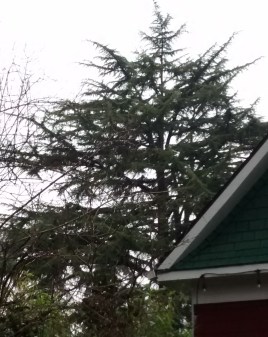
Deodar

deodora-2

“We wish to become a pine tree with the wind singing in our branches, because we believe that a pine tree does not suffer.” Thich Nhat Hanh, The Heart of the Buddha’s Teaching.


We live under the canopy of the Deodar
with long, horizontal, drooping branches
overreaching our home, calming our senses;
a green and lush canopy of cedar stillness
in graceful boughs, undulating, breathing
with each push of air, each alighting bird.

How little we know of life in our several seasons
but that we care, we love, and we suffer.
We imagine what may yet bring suffering
and with every stir of a portending wind –
flutter, breeze, gust, or gale –
we search for ways out of its grasp.

Over us the Deodar resides, layered
in long limbs hovering in somber reaches,
from whose masses of green and gray
come solace for suffering as it suffers not.
From its heights it drips rain in nourishing showers
wafts about it a green swirl of silence
like whispering words about living and dying,
of nirvana and the end of suffering.


Portland, Oregon – February 17, 2017

The Deodara cedar is common in Cascadia and in our own yard in which two younger versions are ascending to 20-30 feet near the giant in my photo.  Interesting that the name “Deodar” is from the Hindi deod ā r < Sanskrit devad ā ru, equivalent to deva god + d ā ru wood, or, “wood of the gods.” The OED uses “timber” of the gods.  This noble appellation is apparently given due to the hardness and durability of the wood.  Nice to know!

Photo is my own, taken on February 17, 2017
Dutch Elm Disease and the Birch Grove

birch-snag

I was surrounded by trees when I was a boy –
cedars mostly and three apple trees with sad fruit.
In front, branches hanging over State street, lived two Dutch elm trees.
They had a tree disease and someone cut them down.
I knew those two trees as a boy –
squirrels racing along their branches,
birds flying about in their branches.
My father said, “they have Dutch elm disease.”
It meant nothing to me.
I came home from school one day and they were gone.
I didn’t mourn.  I looked at the stumps then went on with boyhood.

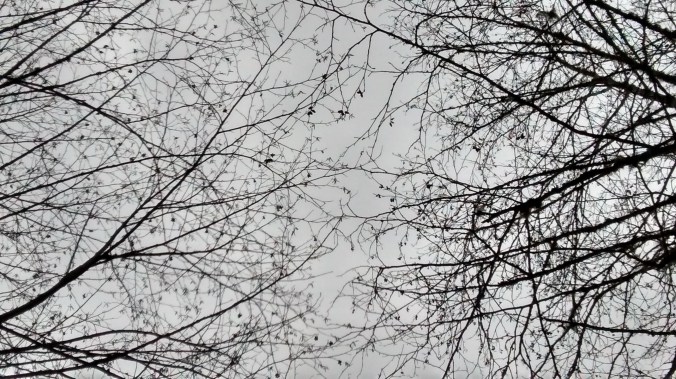
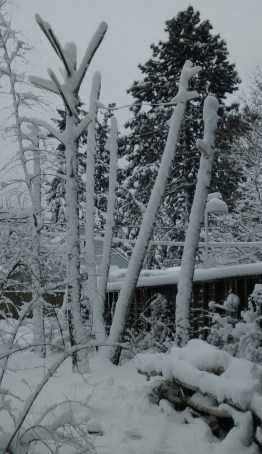
Today, men came to my yard and cut down my birch trees.
They have a disease, they said, the bronze birch borer disease.
They are dying so they must be cut down –
nothing left but to make them into wildlife snags.
Bugs will live in them and birds will come to feed on the bugs.

It is painful being an adult, saying, “cut down those trees.”
“Those trees have the birch borer disease, so they must go.”
Now they are gone – the leaves gone –
the small spring green leaves, yellow autumn leaves,
the tangle of thin whippy branches.

Come on bugs and birds!
What’s left of my birch trees is all yours now –
I wait for you to come with spring after this long winter.


Portland, Oregon – January 10, 2017

Photo is my own, taken this date after the largest snowfall in Portland in a long time! The trees were cut the day before.

Two Trees

img_20161226_161109765_hdr

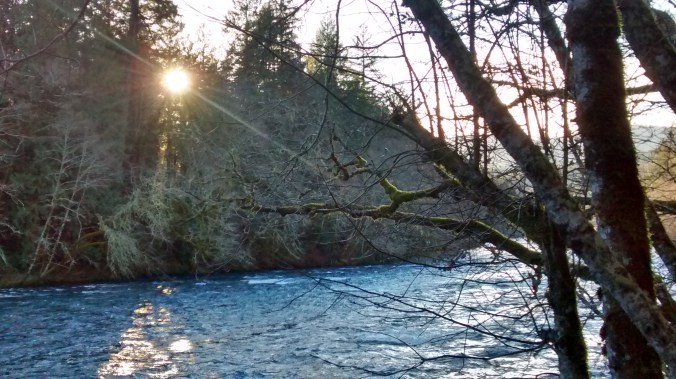
Along the banks of the McKenzie
two trees stand over a cold Christmas flow
of rippled waters in thrilling rush.
One day the McKenzie will take them with her
but for now they remain, leafless in afternoon light,
stripped of but branch and bud by winter.

I came to see the river
yet what do I miss when I see
what I come to look upon?
This – beauty bare branches in a wind flown sky
flailing long arms in the breeze and water surges –
like young girls racing along a summer beach.


Portland, Oregon – January 4, 2017

Photo is my own, taken on December 27, 2016 above the McKenzie river, Oregon.

Here is the river:

mckenzie-river-afternoon-12-28-16

Fading Coal

Waiting…

Waiting…

Wind flutter on fading coal
in this longing season –
shrouded sun hanging low
over the gauzed and furry horizon –
the reaches of self and the world.

Wind, tree rustling cold bare branches,
thrilling spaces between dark limbs
quavering deep reaches
of space beyond our pale light,
trilling starlight gleams while stellar grains
float broadcast in cosmic fields.

Poetic dream to be wind brushed
hushed into warmth of words
from within, hidden in heart shadows,
the heat of breath on cold winter nights.


Portland, Oregon – December 14, 2016

“Poetry is not like reasoning, a power to be exerted according to the determination of the will. A man cannot say, “I will compose poetry.” The greatest poet even cannot say it; for the mind in creation is as a fading coal, which some invisible influence, like an inconstant wind, awakens to transitory brightness; this power arises from within…”

Percy Bysshe Shelley, In Defense of Poetry (paragraph 39)

http://www.bartleby.com/27/23.html

Ode to Cascadia

188px-Flag_of_Cascadia.svg

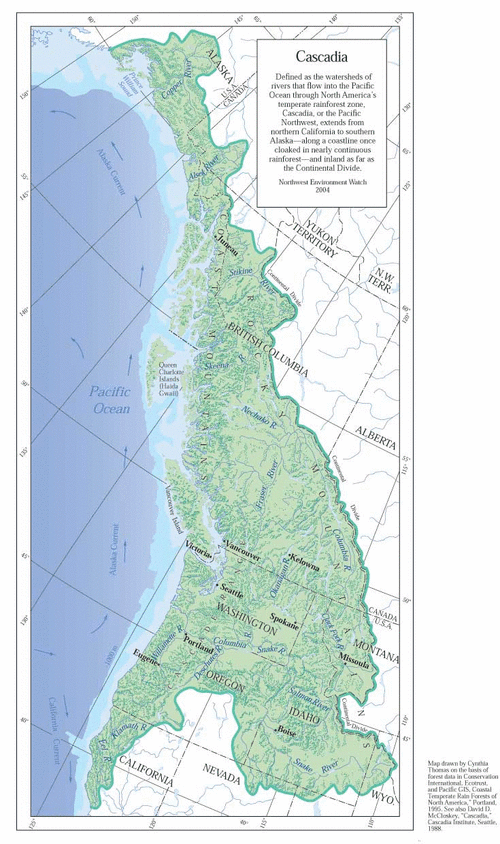
If I say, as the title of my site indicates, that I write in Cascadia, I must be sure I understand what that means.  I must want to be defined by a place so beautiful, but for what reason?  Why not say, simply, “Tom Writes” and let it be done with?  Is my own beauty, such as it is, not sufficient for the task – the creative and necessary task of my days?  I suppose it is justification enough to say that, as a writer, I require a muse. Cascadia is a stirring muse; she is a breathtaking representative of all the muses of my life – person, place, or word.  Let me then be old-fashioned and offer an Ode to Cascadia.


I looked down from a high tower
into your valleys, your mountain green meadows
wildflowers all abloom in abandon
and saw there my own self
wandering, infinitesimal, on a trail below.
A path wandered by the black bear,
by the ancestors who called the mountain home
named it, Ti’Sqaq – Who touches the sky.
The rivers and salmon were their friends –
the grandmothers and grandfathers
I cannot claim as my own.

I saw you walking there below the broken cloud layer
underneath the great trees
wide, so that you could not put your arms around them;
tall, so that you could scarce see their fringed tops –
they dwarfed your skinny frame.
You stopped beside a stream of fresh flowing water,
rock strewn freshets of clear and cold companionship-
splashed your face, dipped your hat,
sat to consume your meal.
You watched the stream rush past you,
knew it was on its way to the sea
but could not hear that distant roar –
crashing waves, billows curled, flung in windblown rain.
There the stream was lost
having found its way at last
to the place where you also were going.


Portland, Oregon – February 18, 2016

To see a picture of the tower I refer to, please see the photo, above.  To see a photo of the valley that forms the inspiration for this piece, please see my About page.  The trail is visible on that page.  You cannot, however, see me down there.

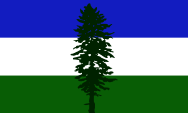
The flag in the upper right is the proposed emblem of Cascadia.
slide_340949_3511831_freeslide_340949_3511831_free

The Ash Tree

Ash tree, leaf full, is startled in cloud break sun splash
morning, dropping dew from the crisp spring damp
after a full dark, moonless, cold night.
Gray wren alights, sips from leaf tips, flys away.
Dripping ash,
recovering from this flurry of flight and bright,
returns to calm waiting for lifting air –
forgotten, the shrouding dark, cloud enfolded night.

Awaited air movement comes in soft rush
ruffling sun-soaked green ash leaflets,
blowing to the waiting ground
fresh dew droplets clear and cool.
The wren waits.
Silent worm emerges from nightly repose,
drinks of sun, breeze, cool dew –
becomes gift, gulped in a long stretch.
The wren, satiated momentarily,
takes up a perch once again within the mindless ash.


Portland, Oregon – March 2014

Winter Life

Leaves, waiting, cling to cold branches
on trees beside a watercourse,
restless, brittle, resolute.
They twirl in solemn anticipation,
green life gone; spring breath lost –
swift passing season.
Brilliant light sweeps across frozen mesquite and sage,
gathers in rock, cliff, wash, basin,
severs – quiet, unknown mystery – the last hold.
They come down – wintry life swirling in the desert wind.
___________________
Reno, Nevada – 1989