Cold Spring Wind

Listening to Finlandia in the cold early spring
as an indecisive wind wonders where to go
whether to slash at the high tops of cedars
or to ruffle the feathers of birds hopping through the yard.
It has forgotten, apparently, its place –
to bring winter snow or spring rain?
It wanders about, as if seeking help
assistance from unseen galactic and geologic forces.
It threatens reluctantly,
unlike boastful November winds, full of storm and fury
Knowing full well they can bring what they portend.
these poor spring winds – cold, skittish –
threaten the buds on branches baring themselves,
unafraid to be touched by that breath.
It stings at insolent daffodils, smiling, waving gaily
at the toothless assault waged on them.

Ah, but here comes the rain again, slanting.

Not so toothless yet, I see.


Portland, Oregon – March 12, 2016

Inspiration from The Kalevala,  or “Poems of the Kaleva District”, Compiled by Elias Lonnrot.  The Kalevala is the national folk epic of Finland.
Morning Bowl of Surreal

White, round, deep
with spoon.
Poured milk
flakes from fields
cane sugar
blueberries.
One mouthful at a time
breathe in – out.
Once more.
The day has begun
with rain.

The bowl never empties.
The day pours in
filling it to the rim
over again and over
until it spills
with light and dark
splashes on the countertop.
The abundance
cannot be stopped
or spent.
I need another bowl.


Portland, Oregon – March 6, 2016

What They Could Not Say

A deep and numinous grief awakens, disquieting,
thinking about my father
who worked with tools, built a house,
found a job at last that gave him peace.
On his hospice bed he saw visions of friends long dead
as if calling him into the past, welcoming him
to the place where they hunted deer and told stories.
What they spoke of he did not say.

Or, my sweet mother, hiding her smile,
who did not tell her story and we never knew.
She slipped one day on the ice at Silver Valley
and, at seven years old, I knew she was mortal
but the word I did not know.
Perhaps she told her stories to friends
as they drank bitter coffee at the drug store soda fountain.
If she saw visions of her friends in the nursing home, before her last sickness,
she did not say.

What desires, felt deep, of longing and remembrance,
could they not say;
stories of loneliness and fear
of someone they loved
but could not say
could not hold that hand anymore?
What dreams in secret float like clouds over the world
of those who have seen visions and passed on
taking their stories with them?
They could not say.
The clouds endless pass in sweeps, billows, and storm
round and round and round they go.


Portland, Oregon – March 5, 2016

Inspired by Gilgamesh, a Herbert Mason verse narrative translation of the ancient and noble Babylonian epic.  I highly recommend anyone to read this great work and especially this most poetic translation.  Here is the particular verse (p. 54):

“For being human holds a special grief
Of privacy within the universe
That yearns and waits to be retouched
By someone who can take away
The memory of death.”

The Light, the Wall, and the Spider

Writing in the cold night-wrapped garage under a single light
clamped precarious to rough lumber hung on pegboard
over table meant for working wood, mind working instead.
Hard surfaces, bare and cracked concrete, cold cheap tools,
dust and blown in leaves, dead insects,
black widow spiders stealthy hidden in dark places.

The cold is close, biting at ungloved finger tips,
scratching to get further in, through thin walls
to reach some organic and pliant space, of flesh and doubt,
where it may infuse to a depth physical – imminent –
to grasp and pull back out through the wall
a flailing homebody, miserable excuse for an adventurer,
into spaces liminal and transcendent.
One light to hold back the claw and tooth of the dark
black against the window, empty even of stars.

Writing on an island in the sea of infinite mystery –
a light, a wall, and a spider –
protection from the encroaching sea-filled blackness
flimsy barriers against the chill waves of the cosmos and the divine
where exist no sharp edges, curved surfaces, or idyllic scenes.
No theology, religion, creed, or dogma tonight –
just what was, is, and forever shall be.


Portland, Oregon – February 29, 2016

Inspired by Karl Rahner in Foundations of Christian Faith (1978, p. 22):

“In the ultimate depths of his being man knows nothing more surely than that his knowledge, that is, what is called knowledge in everyday parlance, is only a small island in a vast sea that has not been traveled.  It is a floating island, and it might be more familiar to us than the sea, but ultimately it is borne by the sea and only because it is can we be borne by it….Hence the existential question for the knower is this: Which does he love more, the small island of his so-called knowledge or the sea of infinite mystery?”

Violet Gray

Violet gray
winter abandoning
bird trembling
in violet gray.
Stones in desert foliage
speak of Christ
violet flesh
gray eyes
troubled, fearful.
Fire on the water
water violet gray
in the morning.
Hymns, antiphonally,
Gregorian tones
in violet gray.
Hush! Hush!
whispered season
a waiting, afraid
of violet bursting
gray emanating
dubious death
questioned arising.


Menlo Park,  California – March 9, 1984
Lenten Series

Another Life

I am alone with the quiet and the chilling sunshine
the ticking clock and wind-blown light
nothing to do that must be done.

I’ve left my work life behind me
paid days of anxious scribbling;
spreadsheets, meetings, report drafts, coffee
while I gazed out my cubicle window over the Salish Sea
plied by ferries moving white and green across the sea’s deep blue.
Or, I looked long into the dense fog of winter dark early mornings –
fog creeping silent up to my own window high above
so that neither ferry nor sea could I behold –
just a gray shimmer quavering shadow,
ghostly hovering there before my eyes,
suggestive of an unknown, future, less scripted life.
I watched, as the mindless gray gave way to a full and lustrous winter crisp moon
crackling white in the cold dark morning.
Its brilliance washed the water’s expanse with a rippling shimmer of moonlight,
illumining the churned and opalescent wakes of ferries,
shining as if on ships making their ways to heaven across a vast sea
to where the moon itself lives when it sets over the western horizon.

Oh, how I then complained of my tedious days of work,
the numbing aspect of time ground to a halt.
My companions allowed me to expound at length,
on the baffling politic of management concern!
These are such companions as one needs in life,
who see you through the hours of countless working days
and are content to have you return again the next
in spite of all manner of gruff, and you understand they are true –
the good fortune of work, forgiveness there, and a task, well done at the last.

Still, it is the moon over the sea
the sun’s shine on the mountains snow-capped peaks
the ferries slow movement over the water
and the curling, implacable fog I remember
from the days when I was paid for the work I did
unlike today, with its ticking clock, its windblown light
and with nothing to do that must be done.


IMG_2545 (003)

Portland, Oregon – February 23, 2016

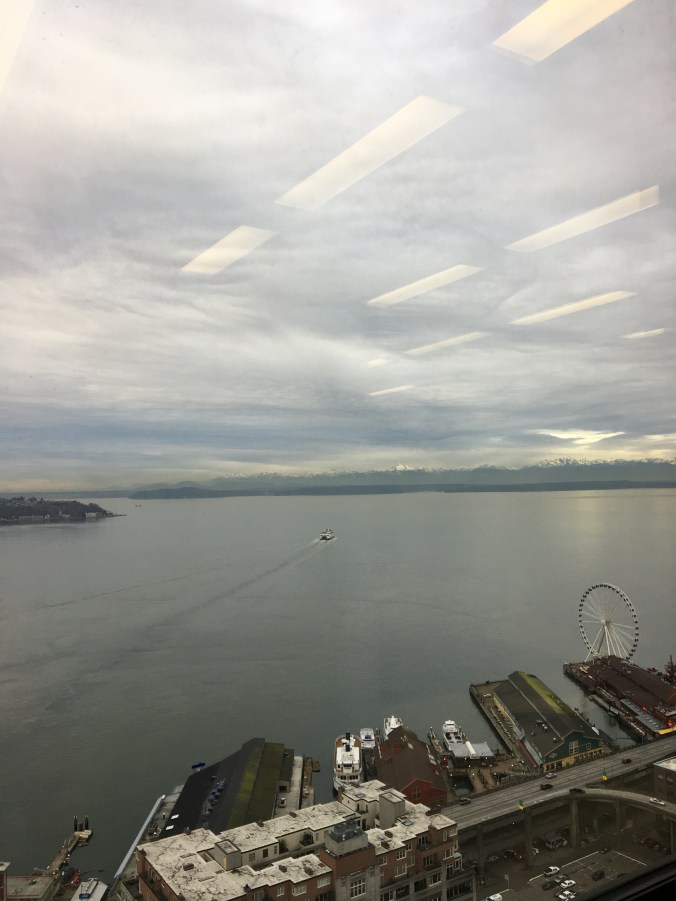
The picture, above, is of a small portion of the Salish Sea, otherwise known as Puget Sound, on which sits the great city of Seattle.  The photo was taken through what was my cubicle window by a colleague who now claims that view. I thank her for this.

Ode to Cascadia

188px-Flag_of_Cascadia.svg

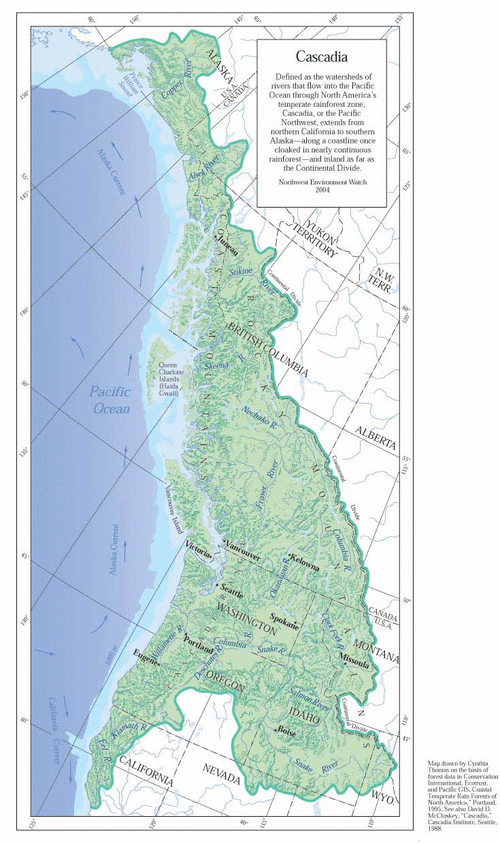
If I say, as the title of my site indicates, that I write in Cascadia, I must be sure I understand what that means.  I must want to be defined by a place so beautiful, but for what reason?  Why not say, simply, “Tom Writes” and let it be done with?  Is my own beauty, such as it is, not sufficient for the task – the creative and necessary task of my days?  I suppose it is justification enough to say that, as a writer, I require a muse. Cascadia is a stirring muse; she is a breathtaking representative of all the muses of my life – person, place, or word.  Let me then be old-fashioned and offer an Ode to Cascadia.


I looked down from a high tower
into your valleys, your mountain green meadows
wildflowers all abloom in abandon
and saw there my own self
wandering, infinitesimal, on a trail below.
A path wandered by the black bear,
by the ancestors who called the mountain home
named it, Ti’Sqaq – Who touches the sky.
The rivers and salmon were their friends –
the grandmothers and grandfathers
I cannot claim as my own.

I saw you walking there below the broken cloud layer
underneath the great trees
wide, so that you could not put your arms around them;
tall, so that you could scarce see their fringed tops –
they dwarfed your skinny frame.
You stopped beside a stream of fresh flowing water,
rock strewn freshets of clear and cold companionship-
splashed your face, dipped your hat,
sat to consume your meal.
You watched the stream rush past you,
knew it was on its way to the sea
but could not hear that distant roar –
crashing waves, billows curled, flung in windblown rain.
There the stream was lost
having found its way at last
to the place where you also were going.


Portland, Oregon – February 18, 2016

To see a picture of the tower I refer to, please see the photo, above.  To see a photo of the valley that forms the inspiration for this piece, please see my About page.  The trail is visible on that page.  You cannot, however, see me down there.

The flag in the upper right is the proposed emblem of Cascadia.
slide_340949_3511831_freeslide_340949_3511831_free

Mercy

It is curved, old, deep –
punctured, stretched, twisted.
Emptiness fills its hollow core.
A vibrant electric thrum
bumps along the walls
of this place we know –
do not want to know –
pushed behind our hidden door.

It beckons us from there –
knock, knock, knock.
Our deepest past
calls to us from remote well-springs,
life-bearing pools that seem, in dreams,
to be precipices, hidden caves, cataclysmic seas.

Silence, its name and substance,
waits for us to still, remember, open the door
to let in, at last, sweet mercy –
handmaiden of the living god
however we name her or call the holy.


Portland, Oregon – February 14, 2016

Lenten springtime-Year of Mercy

Thicket

Ash 2Thicket, tangled winter barren,
through which small birds pass with ease.

I cannot pass through my own thicket,
its branches every which way crossing
bending, diving, reaching,
creating celestial star tracks
floating grains of blown ash
from fire, pyre, or soul
burning days behind,
wandering from time into eternity.


Ash Wednesday – February 10, 2016
Portland, Oregon
My photo is of our snowberry (symphoricarpos) in winter.

Animal Shadows

I saw my own shadow today, briefly
in the pale, drear, moss encrusted northwest green.
It did not seem to care about winter or spring
or even that I cast it lightly.
It seemed careful, I suppose,
only for the ground over which it passed.
I was concerned about many other things.


Portland, Oregon – Groundhog Day, February 2, 2016